

Draugr
Th undead warriors from Scandinavian saga literature and folktales.

Fans of Icelandic saga literature, The Elder Scrolls: Skyrim and Robert Egger’s The Northman will be familiar with the draugr. These restless, undead beings often awaken when disturbed in an attempt to satiate their unquenchable bloodlust. The Old Norse definition of draugr is "a ghost, or spirit” but more specifically the dead inhabitant of a cairn. This is misleading however as the draugr are actually more like revenants - a spirit or animated corpse that is believed to have been revived from death to roam the land and haunt the living. Alongside the standard draugr is the haugbui, but they cannot leave their grave site to cause havoc on the living but still attacks you if you trespass. Even so, they are often depicted guarding treasure buried in their burial mound.
They are a big part of Scandinavian saga literature and folklore, as a result there are many names for these revenant beings - Old Norse: draugr; Icelandic: draugur; Faroese: dreygur; Danish & Norwegian: draug and last but not leas in Swedish: draug, dröger, drög. Alongside the names haugbúi ("barrow-dweller") or an aptrganga, literally translated as "again-walker".
Much like the modern day depictions of zombies, draugr reek of decay and are generally hideous to look at - specifically they were described as hel-blár "death-blue" or nár-fölr "corpse-pale". The draugr of Grettir the Strong’s saga, Glámr was described as "blár sem Hel en digr sem naut” (black as hell and bloated to the size of a bull) when he was found dead and draugr-like. Another example of this fetid and rancid image is in Hromund Gripsson’s saga, where Þráinn (Thrain), the berserker of Valland, "turned himself into a troll". He was described as a fiend, "black and huge.. roaring loudly and blowing fire", and also possessed long scratching claws. These claws stuck in the neck, prompting the hero of the saga, Hrómundr, to refer to the draugr as a sort of cat - the Old Norse word kattakyn appears in the saga and alludes to this cat-like feature.
Ármann Jakobsson in his article Vampires and Watchmen: Categorizing the Mediaeval Icelandic Undead in volume 110 of The Journal of English and Germanic Philology states “The main indication that a deceased person will become a draugr is that the corpse is not horizontal. It is found standing upright (as with Víga-Hrappr), or in a sitting position (Þórólfr), indicating that the dead might return.” The draugr’s primary motivation is envy and greed. Greed helps it fight any would-be grave robbers and the envy of the living stems from a longing for the things of life which it once had. The draugr has an insatiable appetite and merciless bloodthirst, it is known that any cattle grazing near their mound would be driven mad and some draugr kill animals by running them to death or riding them until deathly exhaustion.
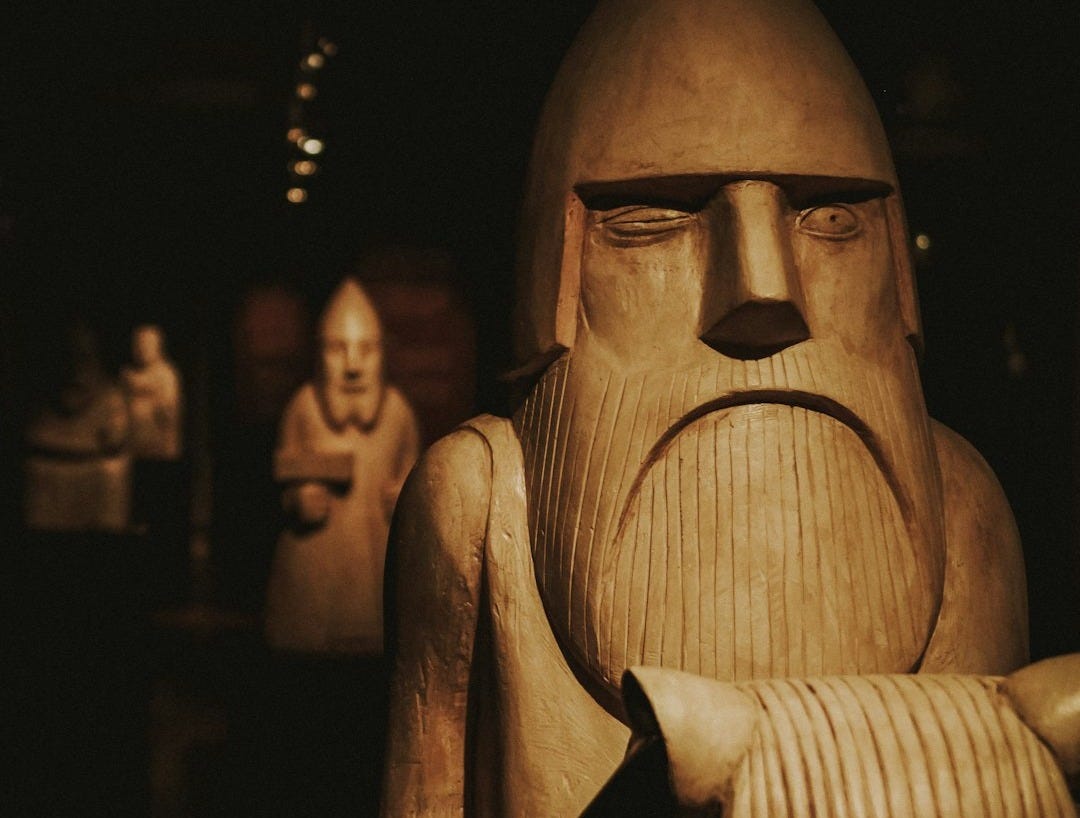
Now imagine that horrible appearance and ruthless desire, combined with superhuman strength and magical abilities, it just got a little more terrifying didn’t it? They are known to have a number of magical abilities such as shape-shifting, controlling the weather, enter into the dreams of the living, cursing people, temporary disease in the area where they roam and seeing into the future. Their presence may be signified by bioluminescence in their mounds, much like the fungus that causes foxfire in wood.
Shape-shifting is usually ascribed to the Icelandic revenants, they most commonly transform into a seal, but other examples consist of a great flayed bull, a grey horse with a broken back but no ears or tail, and a cat that would sit upon a sleeper's chest and grow steadily heavier until their victim suffocated. The most well-known shape-shifting draugr is Víga-Hrappr Sumarliðason of Laxdaela saga, unlike the usual cairn guardian, Víga-Hrappr has a penchant for not staying put in his burial place but instead roams around his farmstead of Hrappstaðir, causing havoc and menacing the living - sometimes appearing as a seal with human eyes which is a disturbing image to say the least. He also has the ability to sink into the ground to escape a hero’s sword too.
The most terrifying aspect of a draugr is that some of them are impervious to weapons. Only heroes with exceptional strength and courage would be able to defeat these formidable adversaries - Amleth in The Northman for example. To defeat these draugr, heroes would have to wrestle the revenant back into the grave to defeat it, since weapons are useless. Keeping them fully dead and buried though is another matter.

How do you rid yourself of one of these greedy, merciless and bloodthirsty beings? The traditional method involves a simple decapitation to prevent further hauntings - of course this depends if you can get a good swing of your sword on them and they aren’t impervious to weapons. However, some heroes had to resort to other methods of disposal. Starting with the decapitation, you may have to to burn the body and dump the ashes in the sea, just to make sure it’s really dead.
Of course, with any undead problem there are rituals and superstitions around preventing a draugr from popping up in the first place. In Theresa Bane’s Encyclopaedia of Vampire Mythology, it states:
“Traditionally in Iceland, a pair of open iron scissors was placed on the chest of the recently deceased, and straws or twigs might be hidden among their clothes. The big toes were tied together or needles were driven through the soles of the feet to keep the dead from being able to walk. Tradition also held that the coffin should be lifted and lowered in three directions as it was carried from the house to confuse a possible draugr's sense of direction.”
There is also an unconfirmed Danish belief that the body is to be transported through a “corpse-door”. This is a special door in which the corpse was carried through feet-first with people surrounding. This is so that the corpse couldn't see where it was going. This is allegedly founded on the idea that the dead could only leave through the way they entered.

The draugr have made many appearances in popular culture, too many to list here but the main ones I have already mentioned. I find these revenants fascinating because of how varied they can be, there’s even sea-draugr! Having read the sagas that these main ones appear in, even the straight-to-the-point Icelandic style still contains a sense of tension and horror when these undead beings are around.
Considering their smell, appearance and their magical abilities, I believe are far scarier than any modern zombie. It makes you glad that you aren’t a superstitious Scandinavian in the early medieval era, as the thought of meeting a draugr would be enough to keep you up for weeks staring at your local mound. So with Hallowe’en approaching and the veil between worlds thinning, keep your wits - and your sword - about you and I hope you’re fortunate enough to avoid meeting a dreaded draugr (unless you’re playing Skyrim of course, they’re everywhere!). I’ll finish on a positive note though, there is an alternative, ambivalent view of the draugr in Njal's saga. The great warrior of the saga Gunnar Hámundarson is said to sit and stare at the night’s sky:
“It seemed as though the howe was agape, and that Gunnar had turned within the howe to look upwards at the moon. They thought that they saw four lights within the howe, but not a shadow to be seen. Then they saw that Gunnar was merry, with a joyful face.”

Bibliography
Wadstål, M., (17th October 2021), The Draugr, Scandinavian Archaeology
Unknown, (1400s), The Saga of Grettir the Strong, Penguin Classics, Penguin Publishing, translated by Magnússon, E. et al.
Unknown, (1240), Eyrbyggja Saga, Penguin Classics, translated by Pálsson, H., Jónsson, Þ., et al.
Unknown, (1400s), The Saga of the People of Laxardal & Bolli Bollason's Tale, Penguin Classics, Penguin Publishing, translated by Kristjansdottir, B. S. and Kunz, K.
Chadwick, N. K., (1921), Stories and Ballads of the Far Past, Cambridge University Press
Simpson, J., (1972), Icelandic Folktales and Legends, University of California Press
Unknown, (1270), Njáls saga, Penguin Classics, Penguin Publishing, translated by Cook, R.,