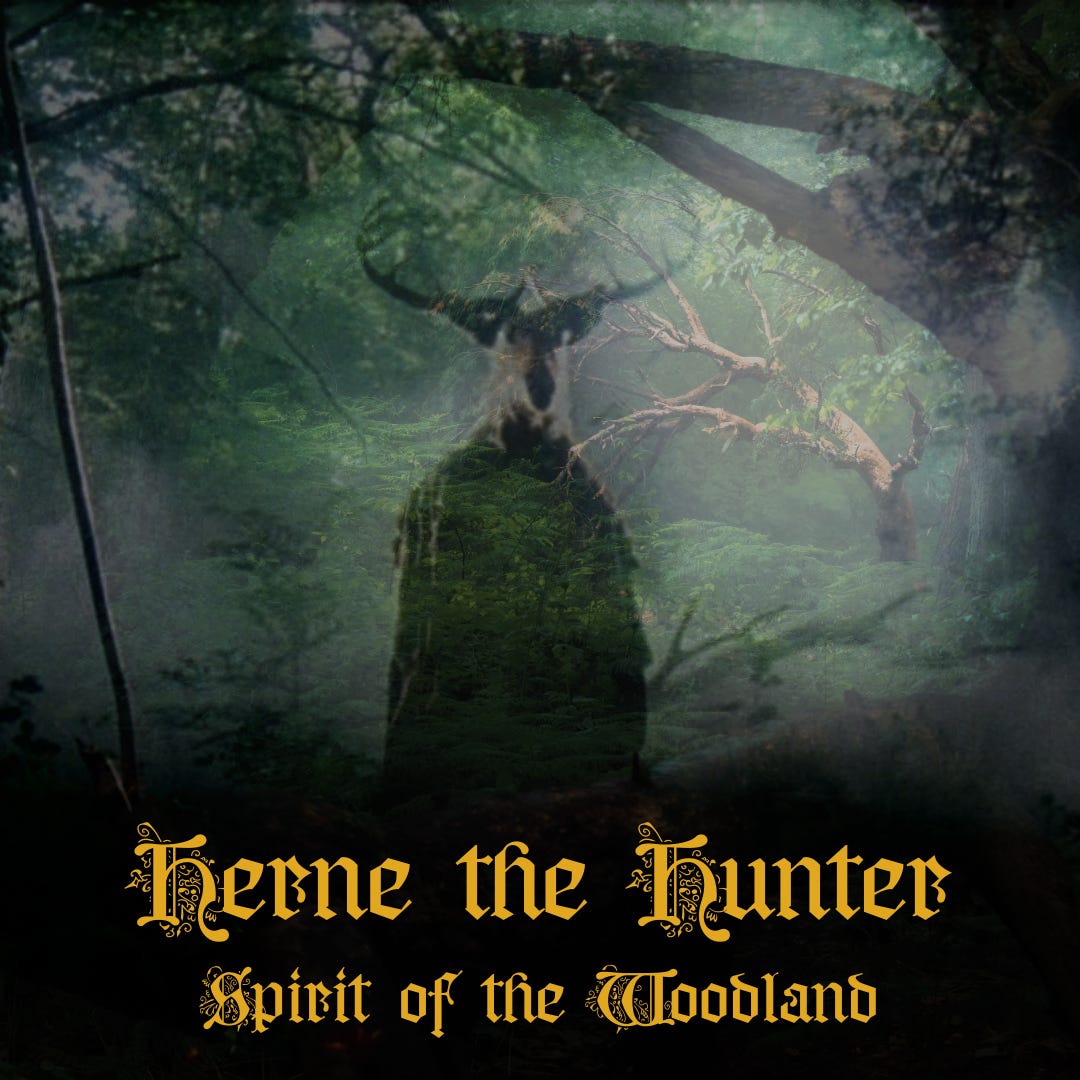
Herne the Hunter
The spirit of the woodland
When I hear the opening notes of Clannad’s ‘Herne’ from their seminal Robin Hood soundtrack Legend, it takes me back to my childhood. The crackle of the original vinyl and the ethereal nature of the music fired my imagination continuously. Clannad also appeared on long drives in the car across various countryside areas across England and Wales with my dad, as he played the band’s 1999 compilation Celtic Collection on CD. Clannad’s music is one of the sounds of my childhood - alongside Ronan Hardiman’s Lord of the Dance and Bill Whelan’s Riverdance. This song in particular though is particularly fascinating. It was the theme of the TV series Robin of Sherwood’s semi-pagan deity of Herne the Hunter. The series was created by Richard carpenter and ran for three series from 1984 to 1986.
Robin of Sherwood is considered as one of the most influential adaptations of the core Robin Hood legend since the classic film The Adventures of Robin Hood (1938). Set in a realistic time period between the 12th and 13th centuries - the traditional period in which the legend is set - with events such as King John raising an army to fight Llywelyn of Wales in 1211. As well as introducing the Saracen character - a role Morgan Freeman would famously play in Kevin Costner’s Hollywood blockbuster Robin Hood: A Prince of Thieves (1991).
Alongside this, Carpenter added fantasy elements to the story. Something which had not appeared in previous TV adaptations of the famous English legend. These included; Robin's magic sword Albion, appearances by black magicians and demons and the subject of today’s post Robin's supernatural mentor Herne the Hunter. This character’s enduring image has stayed with me to this day, yet there is more to this folkloric legend than semi-pagan mentor.

The earliest written account of Herne comes from Shakespeare's play The Merry Wives of Windsor - believed to have been written in 1597;
“There is an old tale goes, that Herne the Hunter
(sometime a keeper here in Windsor Forest)
Doth all the winter-time, at still midnight
Walk round about an oak, with great ragg'd horns;
And there he blasts the tree, and takes the cattle,
And makes milch-kine yield blood, and shakes a chain
In a most hideous and dreadful manner.
You have heard of such a spirit, and well you know
The superstitious idle-headed eld
Receiv'd, and did deliver to our age
This tale of Herne the Hunter for a truth.” - William Shakespeare, The Merry Wives of Windsor, Act 4, scene 4
In this play, Herne is said to be the ghost of a former Windsor Forest keeper who haunts a particular oak tree at midnight in the winter time. He is said to have horns, shake chains and cause cattle to produce blood instead of milk - grizzly. It is hard to know accurately where Shakespeare got his inspiration from or how much of the local legend he incorporated, yet there have been several attempts to connect Herne to historical figures, pagan deities, and ancient behavioural patterns. He is considered to be one of the huntsmen that is said to take part in the Wild Hunt motif that appears in many of Europe’s folklore traditions. The Wild Hunts typically involve a chase led by a mythological figure escorted by a ghostly or supernatural group of hunters engaged in pursuit and it is a sign of catastrophe or death ahead if you see one or might also be abducted to the underworld or the fairy kingdom. It is usually lead by the Allfather, Odin.
His legend grew over the centuries with the most recent addition in the 20th century sending a chill down your spine. It is said that his ghost appears shortly before national disasters and the deaths of kings. It was during the 20th century that incidents of personal encounters with his ghost, or of people hearing his hounds and horn in Windsor Forest, were first reported.

His origins however are hard to pin down. The symbolism of the Horned God in ancient European religions, Herne could be more ancient than we expected. In the 1929 book The History of the Devil – The Horned God of the West, R. Lowe Thompson puts forward the theory that "Herne" - as well as other Wild Huntsmen in European folklore - all derive from the same ancient source. Stating that "Herne" may be a cognate of the name of Gaulish deity Cernunnos in the same way that the English "horn" is a cognate of the Latin "cornu". However, Herne is a localised figure, and isn’t found outside the county of Berkshire and the Windsor Forest region. Given that Cernunnos was adopted again on the European mainland and not in Britain, this theory struggles to stand up. However, a more direct etymological source for him may be the Old English word hyrne, meaning "horn" or "corner".
Another possible origin could be from the Anglo-Saxon era. In the Early medieval period Windsor Forest came under the control of the pagan Angles who worshipped their own pantheon of gods. These consisted of gods such as Wodan, whose Norse equivalent Odin rode across the night sky with his own Wild Hunt and hanged himself on the world tree Yggdrasil to learn the secret of the runic alphabet. As a result it has been suggested that Herne is derived from the title “Herian”, which is used for Woden in his role as leader of fallen warriors - the Old Norse equivalent being the warriors of the Einherjar).
Some theories suggest that Herne is the unquiet spirit of a real individual, given that Herne is apparently a purely local figure supports this theory. One person who is supposed to be Herne is the ghost of Richard Horne, a yeoman during the reign of Henry VIII who was caught poaching in the wood. It was the Shakespearian scholar James Halliwell-Phillipps who made this suggestion and identified a document listing Horne as a "hunter" who had confessed to poaching. Alongside the earliest edition of The Merry Wives of Windsor spelling the name "Horne".
Whatever his origins, Herne is a mystical figure in English folklore and one that I am drawn to as a spirit guardian of the woodland. Every time I hear Clannad’s song and see him in the Robin of Sherwood series I’m reminded of this unquiet spirit. Like so many things in folklore the mystery surrounding these legends is what entices you in and enables you to carry them on in your own mind, helping them live through the ages. I shall leave you to decide which is the most plausible origin, but remember to respect the woodland or Herne may appear before you.